Some IPL Venues Make Chasing Almost Pointless
The data reveals a sharp split across IPL 2026 grounds: at some venues, winning the toss and chasing is free runs; at others, it is a slow walk into a trap that quietly destroys your NRR.
KEY STATS:
The playoff conversation in IPL 2026 is almost entirely about points. Who needs to win. Who can afford a loss. Which combinations of results keep which teams alive. The number that is actually going to decide one or two of those four spots is NRR, and almost no one is asking the question that determines NRR before a ball is bowled: where are the remaining games being played?
Not all IPL venues treat chasers equally. The gap between the best and worst chasing grounds in this season's data is not a rounding error. It is the difference between a tactical advantage and a structural trap, and several teams in the playoff race have been playing the wrong game at the wrong grounds all season.
Start with Hyderabad. In IPL 2026, the Rajiv Gandhi International Stadium has averaged 202 in the first innings across the matches it has hosted, with teams batting first winning three of those four encounters. Despite that, captains winning the toss there have consistently chosen to field first, citing dew. Significant dew is expected from the 12th to 14th over of the second innings at the venue, which theoretically tilts the balance towards chasers. The theory and the results have diverged. Three-of-four wins for teams setting the total is not a minor deviation from expectation. It is the surface telling you something the dew narrative is obscuring: when first-innings scores average 202, the chasing side cannot afford a single top-order collapse without haemorrhaging NRR even in victory.
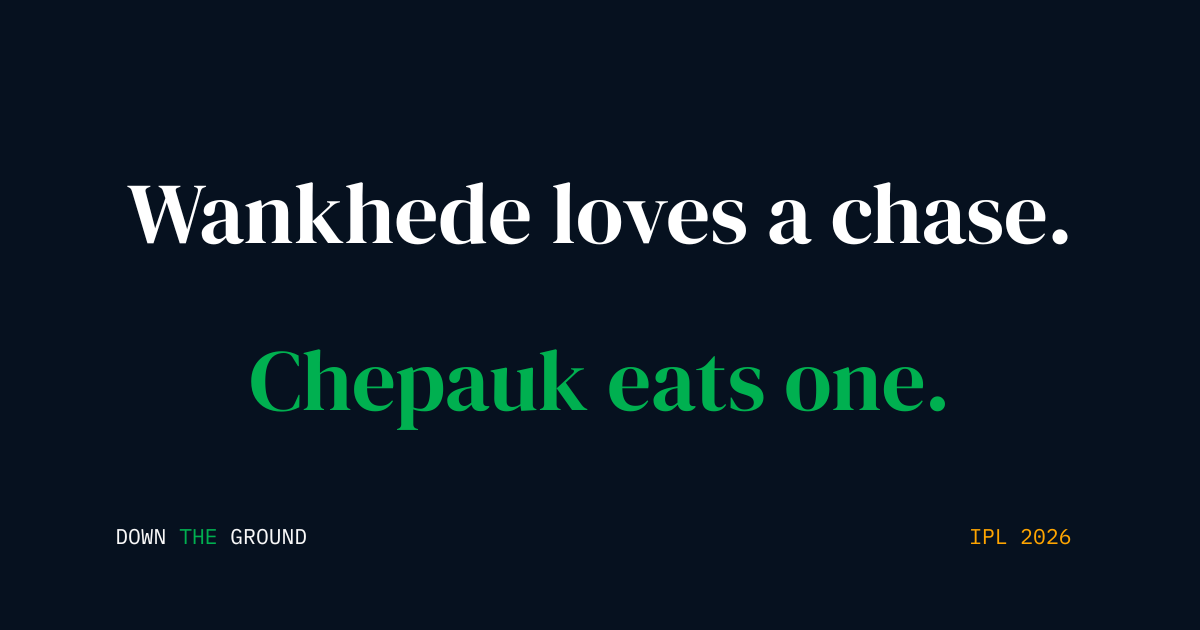
At the opposite end of the country sits Chepauk, where the historical record is unambiguous. Chasing teams win only 43.5% of the time at Chepauk, making it the toughest IPL venue to bat second. Across 92 IPL matches, teams batting first win 56.5% of the time, a gap consistent enough to constitute genuine structural advantage for the defending side. What makes Chepauk specifically dangerous from an NRR perspective is the first-innings ceiling. Only 16 first-innings scores in 92 matches at the venue have crossed 200, meaning Chepauk suppresses totals while simultaneously making them hard to chase. A team that bats second here and loses does so chasing a low total it could not reach, not a high one that battered their bowling. The NRR damage from a narrow Chepauk defeat is disproportionate to the actual score. CSK have exploited this for years: their 68% home win rate at the ground did not come from superior talent alone, but from turning a modest first-innings average of 164.6 into targets opponents find extremely difficult to chase.
Chepauk suppresses first-innings totals to an IPL-low average of 164.6, then makes them almost impossible to chase. Lose narrowly there, and your NRR takes a hit out of all proportion to the score.
The venue nobody has quite figured out tactically this season is Dharamsala. Since the start of 2023, teams batting first have won four of the five IPL games played at the HPCA Stadium. Yet when DC captain Axar Patel won the toss there in Match 55 this season, he chose to bowl first, citing early moisture. His side lost. The counterintuitive reality at Dharamsala is that the high altitude and cool evenings work against the chasing team rather than for it. The highest successful chase at the ground in IPL history is 193, and that was achieved over a decade ago. Teams arriving in Dharamsala and reflexively fielding first are making the same mistake with the same data available to correct it.
Dharamsala is the most misread venue in the tournament. Teams batting first have won four of the last five IPL games there, but captains keep choosing to bowl. The data has been available. The decisions have not followed it.
Wankhede is where the picture inverts. In IPL 2026, every single innings score at the ground has breached 190, with the average first-innings total at 218. But unlike Hyderabad, Wankhede's coastal geography and consistent dew mean that the chasing side genuinely benefits from the conditions later in the evening. Teams batting second at Wankhede have won 70 out of 128 IPL matches all-time, a 54.7% chase success rate that is the inverse of Chepauk. At Wankhede, the NRR logic for a playoff-chasing side is to bowl first, defend a massive score if they can, or use the dew-aided chase to win big and boost NRR in the process.
The direct consequence of this venue split is now visible in the points table. Delhi Capitals face the toughest challenge of any remaining contender because of their net run rate. They must win both remaining matches and improve their NRR significantly, while also needing several other results to go their way. DC's NRR currently stands at minus 0.993, the worst of any side still in contention. A portion of that damage was accumulated at venues where their tactical choices compounded surface effects.
| Venue | IPL 2026 Avg 1st Inn Score | Bat-First Win % (2026) | Historical Chase Success % | NRR Impact Type |
|---|---|---|---|---|
| MA Chidambaram, Chennai | 186 | 40% (2 of 5) | 43.5% (all-time, 92 matches) | Punishes chasers: low totals, low chase rate |
| Rajiv Gandhi Stadium, Hyderabad | 202 | 75% (3 of 4) | ~45% | Punishes chasers: high totals, bat-first wins |
| HPCA Stadium, Dharamsala | ~160 | 80% (4 of 5 since 2023) | Highest chase: 193 (all-time) | Strongly punishes chasers despite low averages |
| Wankhede Stadium, Mumbai | 218 | ~35% (chasers dominant) | 54.7% (70 of 128 all-time) | Chase-friendly: dew, flat track, high scores |
| Narendra Modi Stadium, Ahmedabad | 181–195 | 55% (slight bat-first edge) | ~50% (dew-dependent) | Mixed: dew matters, bat-first edge on certain pitches |
The NRR maths at this stage of the season is brutal and specific. In recent IPL seasons, NRR has decided playoff spots almost every year. In IPL 2024, the difference between fourth and fifth place came down to NRR. A single dominant victory or a heavy defeat can swing a team's NRR by 0.5 or more, which is often the margin that separates qualification from elimination.
For the teams still alive, specifically SRH, PBKS, CSK and RR, the venue of each remaining game is now as important as the opponent. A win that arrives by the run rather than the over costs more than it should. At a Chepauk surface that suppresses scores, a five-wicket win chasing 165 moves the NRR needle almost imperceptibly. At a Hyderabad surface where totals average 202 and defenders win most games, the team that bats first and defends 210 by 40 runs gains as much in NRR as it does in points.
The teams that understand this are already acting on it. The ones that don't are about to discover that the toss is not the only decision that costs you the playoffs.