The Numbers Behind a 36-Year-Old's Unlikely Acceleration
Kohli's strike rate has jumped 20 points in a single season. The data points to structural causes as much as technical ones, and that distinction matters.
KEY STATS:
There is a number that requires explanation. Virat Kohli, at 36, is currently striking at 164.74 in IPL 2026. That is not a number most people associate with an opener who has spent the last decade defending accusations of conservatism in the middle overs. His IPL 2025 strike rate was 144.71. The gap between those two figures, 20 points across a full season's worth of innings, is large enough to ask seriously whether something has genuinely changed, or whether the headline number is obscuring a more complicated picture.
The honest answer, once you work through the data, is: both.
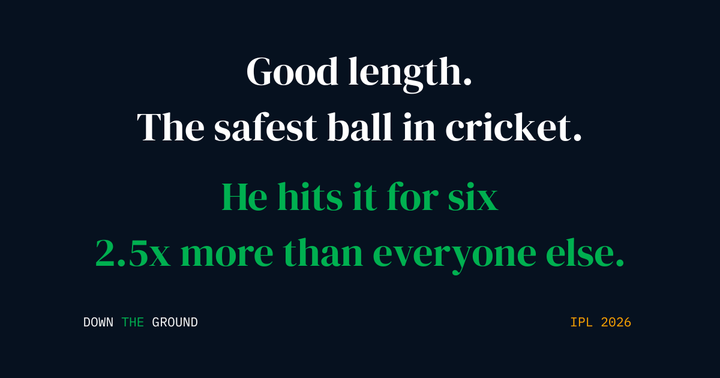
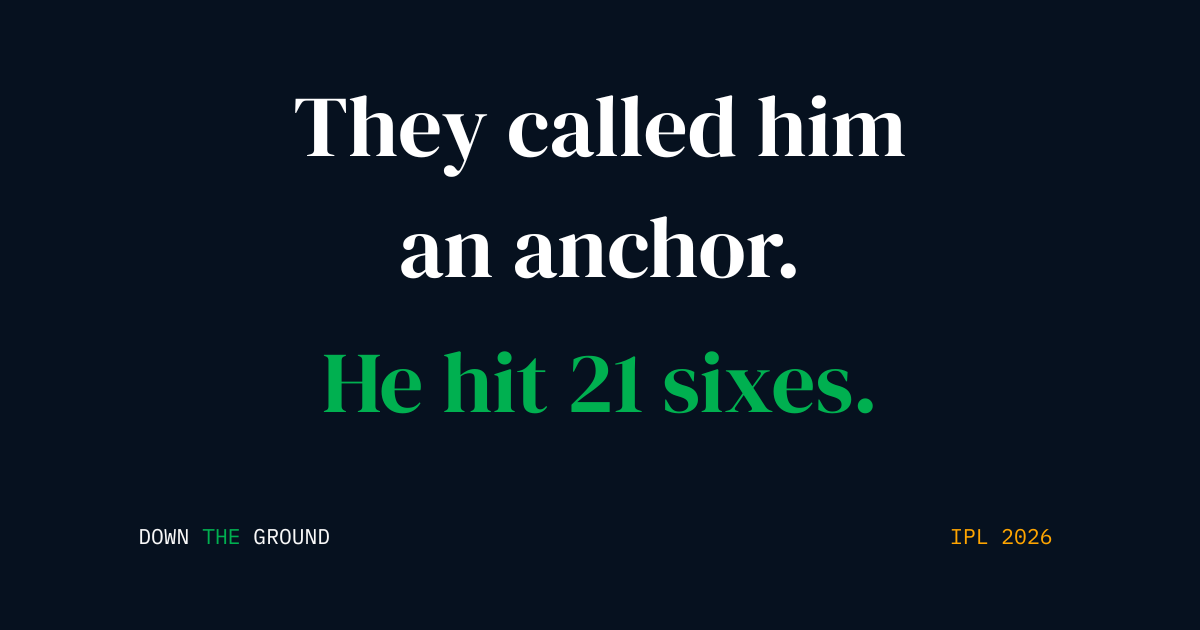
Start with what is real. In IPL 2026, Kohli has struck 21 sixes across 13 innings. Across the whole of IPL 2025, in two more innings, he hit 19. That is a genuine shift in his willingness to go aerial. In IPL 2024, his second-best strike rate season at 154.70, he hit 38 sixes in 15 matches. The current rate suggests 2026 will comfortably surpass that total in fewer innings.
His century against KKR on 13 May is the clearest evidence. 105 not out off 60 balls, including 11 fours and three sixes, at a strike rate of 175, chasing 193. That innings was not the work of an anchor gifted freedom by team structure. It was flat-out aggressive T20 batting from an opener who cleared the rope three times, used his wrists on the leg side consistently, and reached his fifty in 32 balls. By that point in the innings, he had accumulated 30 runs off just 14 balls in the powerplay.
Now for the structural context that mainstream coverage glosses over.
Phil Salt, Kohli's primary opening partner, has been sidelined with a finger injury since April 18. Salt, who struck at 168.33 in his six IPL 2026 appearances, is the designated aggressor at the top. When Salt plays, Kohli can read the situation and choose his moments. When Salt is absent and Jacob Bethell, who has managed just 39 runs across three innings as a replacement opener, is at the other end, Kohli is the senior batter and must carry the burden of powerplay scoring himself.
The paradox is visible in the season arc. Kohli's strike rate through the first four matches was 162.73, already high. Salt was still playing. By match 7, after Salt departed injured, the strike rate sat at 163.18. The numbers were high throughout, not just once Salt left. That complicates a clean narrative about structural enablement.
Yet the season also contains a sharp contradiction in the form of the back-to-back ducks against LSG and MI in early May. A two-ball duck to Prince Yadav, then a golden duck to Deepak Chahar off the first ball, marking only the second time in 19 IPL seasons he had registered consecutive scoreless dismissals. Both dismissals were to pace, both involved a lofted attacking shot that failed to come off. In the LSG game, an inswinger from Yadav crashed through his defence. The ducks tell the same story the high strike rate does: this is a version of Kohli playing with far more front-foot intent than in 2025, which means higher peaks and, occasionally, lower floors.
In IPL 2026, Kohli has struck 21 sixes in 13 innings. Across the whole of IPL 2025, in two more innings, he hit 19. That is not an illusion created by a team structure. That is a batter who is choosing to go aerial more often.
The 2025 season, for all its runs at 144.71, was built on 7 fifties in 15 innings with barely a duck in sight. It was the approach of a player optimising for consistency in a team that went on to win the title. In 2026, the approach is measurably more aggressive. The century rate has increased. The duck rate has too.
The simplest, most accurate description of what the data shows is this: Kohli has not merely been liberated by a deeper batting order. He has made a deliberate choice to attack earlier, at the cost of greater dismissal risk. RCB's batting depth, with Tim David striking at 203.22 in the death in 2025, genuinely enables that choice. But the strike rate improvement is not simply a structural artefact. It shows up in the way his innings are constructed, not just in the final number.
Whether it holds through the playoffs is the actual test. In 2022, when RCB's batting order left him exposed and the team lacked depth, his strike rate was 115.98. In 2026, the team is structurally stronger beneath him. That structure has not caused the improvement, but it has made it sustainable.
The back-to-back ducks tell the same story the high strike rate does: this is a Kohli who is playing with far more front-foot intent than in 2025, which means higher peaks and, occasionally, lower floors.
Virat Kohli - IPL Season by Season (2020-2026)
| Season | Runs | Innings | Strike Rate | Average | Sixes |
|---|---|---|---|---|---|
| 2020 | 466 | 15 | 121.35 | 42.36 | 15 |
| 2021 | 405 | 15 | 119.46 | 30.00 | 9 |
| 2022 | 341 | 16 | 115.98 | 22.73 | 8 |
| 2023 | 639 | 14 | 139.82 | 53.25 | 16 |
| 2024 | 741 | 15 | 154.70 | 61.75 | 38 |
| 2025 | 657 | 15 | 144.71 | 54.75 | 19 |
| 2026 * | 542 | 13 | 164.74 | 54.20 | 21 |
* 2026 figures as of 17 May 2026, league stage ongoing.