A Strike Rate That Should Not Exist at 15
Vaibhav Sooryavanshi's numbers against the world's best bowlers are actually better than his overall average, which makes the Impact Player debate beside the point.
KEY STATS:
The numbers have been accumulating so fast that they are losing their power to shock. So step back from the scorecards for a moment and consider what ESPNcricinfo's Smart Stats are actually measuring. Among every batter to have scored 300 or more runs in any IPL season, across 460 such instances in 19 years of the competition, no one has maintained a strike rate of 238 or above. Not AB de Villiers. Not Andre Russell at his peak. Not Chris Gayle in 2012 when he hit 59 sixes. A 15-year-old from Bihar is the answer, and tonight's 93 off 38 balls against Lucknow Super Giants only reinforced the claim.
The smart objection to this is the Impact Player rule. Rajasthan Royals have deployed Sooryavanshi predominantly as a batting substitute, bringing him in at the fall of a wicket or the start of a chase, shielding him from the fielding duties that the replaced player would otherwise fulfil. The argument, made pointedly by Sanjay Manjrekar, is that this amounts to batting and chilling, a removal of competitive accountability that inflates an already extraordinary talent's numbers by removing one layer of pressure. RR assistant coach Trevor Penney has acknowledged that Sooryavanshi himself is "unhappy" with the role, wanting to field with the team. That detail is worth holding onto.
But look at the data before accepting the objection. The most obvious counter to the soft-bowling narrative is this: against bowlers who have played at least 20 T20Is, Sooryavanshi's strike rate of 236.84 is marginally higher than his overall figure, and his average against this cohort (52.50) exceeds his overall IPL average of 41.09. He is, empirically, harder to bowl at when the bowler is better. That is the inverse of what you would expect from a player being sheltered. Of the 19 bowlers who have delivered at least five balls to him across his IPL career, only four have restricted him below a strike rate of 150. Rashid Khan, Kagiso Rabada, R Ashwin, and Prasidh Krishna. Jasprit Bumrah, Arshdeep Singh, and Matt Henry go at over 250. The problem is not the quality of bowlers; it is the batter.
The deeper data layer makes the case more forcefully. ESPNcricinfo's Runs-Added Impact metric, derived from the Duckworth-Lewis-Stern framework, calculates the runs a batter adds to their team's total on a per-ball basis, penalising early dismissals and rewarding both pace and survival. Sooryavanshi's figure is 0.52 runs per ball. Tim David, the most celebrated specialist finisher in the format, is at 0.38. Heinrich Klaasen adds 5.8 runs per innings to his team's total by this measure. Sooryavanshi adds 8.9. He gets out fractionally more often than the average batter (1.1 extra wickets per 100 balls above average), but the run-scoring rate compensates so handsomely that the model rates him as producing a net gain on almost every delivery he faces.
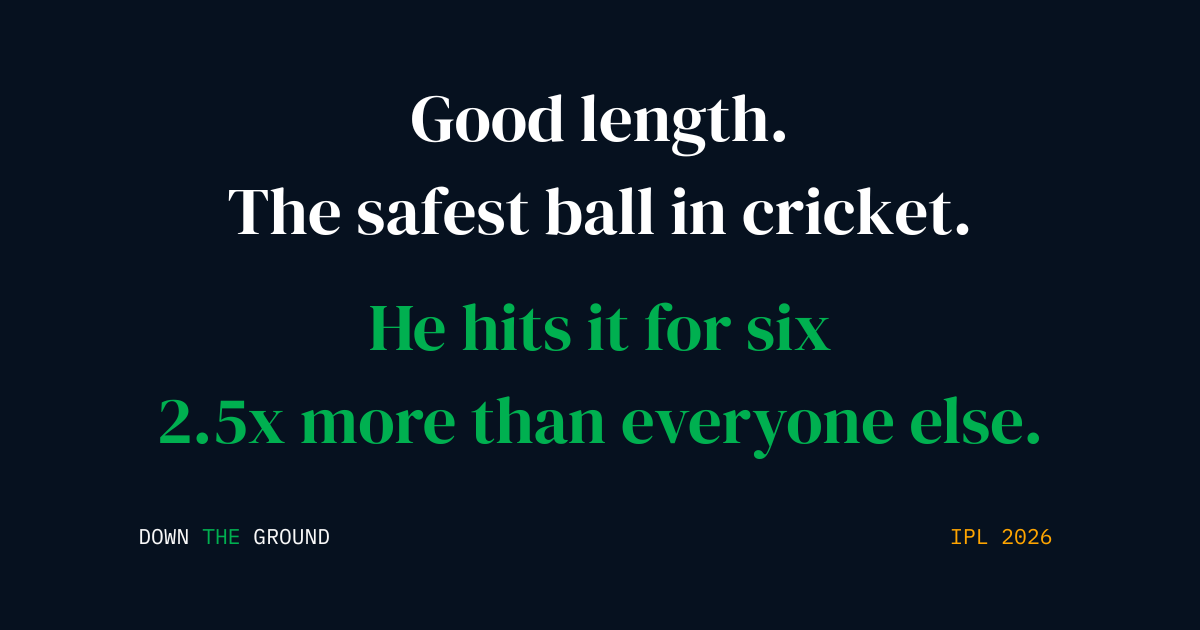
What makes this so analytically unusual is the length data. In the 2025 and 2026 IPL seasons combined, the good-length zone between six and eight metres from the stumps has produced a six rate of 6.6% across all batters. Sooryavanshi hits that length for six at a rate of 16.4%. At the slot length (four to six metres), where the average batter strikes at 206, he strikes at 408. These are not counting-heavy numbers inflated by volume. They are rate stats, independent of how many times he bats or from which position he enters. The Impact Player rule cannot manufacture those conversion rates.
The Manjrekar critique is not without substance. Sooryavanshi is not experiencing the full competitive accountability of a regular playing XI slot: the fielding, the mental weight of knowing that a poor outing costs a team-mate their place, the requirement to contribute in a chase that has already gone cold before he arrives. RR's recognition that he has set a new record for sixes by a Royals batter in any season, at 48 and climbing, is partly a function of the rule allowing him to bat when conditions are most favourable. Those are legitimate developmental concerns that will matter when he plays Test cricket.
But the numbers say something cleaner for the purposes of this season: the Impact Player rule is protecting his development, not his statistics. What he is doing with the bat is real.
| Batter | Overall SR | SR vs Capped Bowlers | RAI per Ball | Runs Added per Innings | Six Rate (Good Length) |
|---|---|---|---|---|---|
| V Sooryavanshi | 234.78 | 236.84 | 0.52 | 8.9 | 16.4% |
| Abhishek Sharma | 210.18 | 181.72 | — | — | — |
| Priyansh Arya | 250.40 | 181.72 | — | — | — |
| Tim David | 245.71 | — | 0.38 | — | — |
| H Klaasen | 155.00 | — | — | 5.8 | — |
| IPL avg (all batters) | ~145 | ~140 | — | — | 6.6% |