The Pacer Who Declined Exactly As Expected, Then Didn't
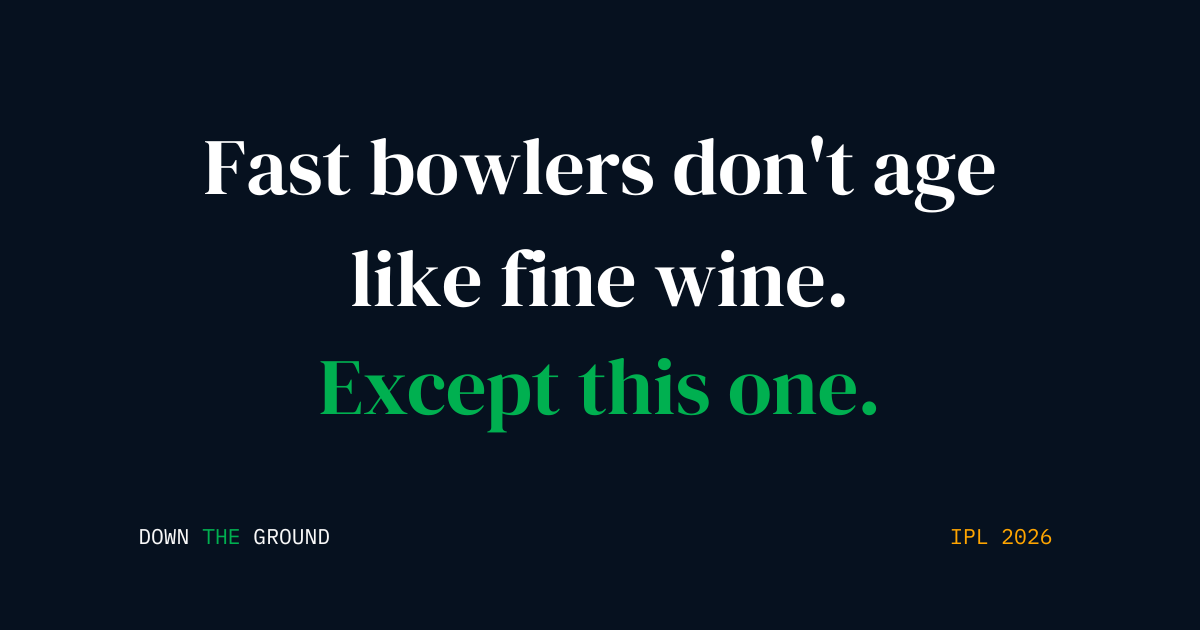
Bhuvneshwar Kumar's IPL 2026 season does not just break records. It breaks the statistical model that says fast bowlers over 33 are finished.
KEY STATS:
There is a standard lifecycle for a fast bowler in the IPL. Rise, peak somewhere in the early thirties, decline, exit. The data says so with unusual clarity. Pace bowling requires explosive muscular output, the kind that degrades predictably with age. Swing bowling, which relies more on wrist position and seam presentation than raw pace, holds up slightly longer, but the IPL's shorter boundaries and flat pitches punish even marginal declines in control. By 33 or 34, the runs come easier, the average climbs, and franchises begin pricing experience below potential.
Bhuvneshwar Kumar's IPL career followed this model almost perfectly, right up until the point it stopped doing so entirely.
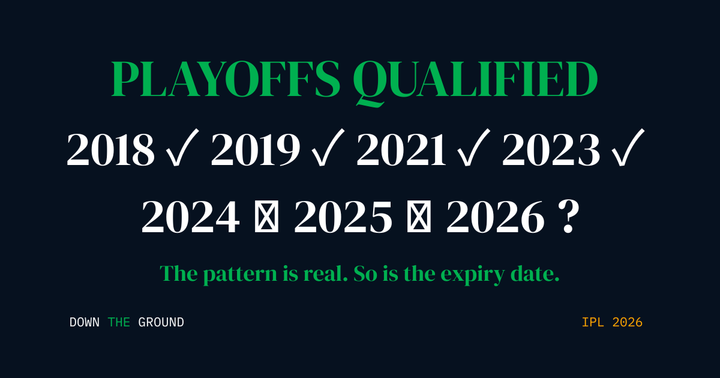
His peak era ran from 2014 to 2017, when he moved from Pune Warriors to Sunrisers Hyderabad. In those four seasons, no bowler in the tournament took more wickets than his 87, and his economy across that block was a lean 7.25. He took the Purple Cap in 2016 with 23 wickets and retained it in 2017 with 26, becoming the only bowler in IPL history to win consecutive Purple Caps. The model said this could not last.
It was right. From 2018 through 2022, the wickets dried up almost exactly as predicted. He took just 43 wickets across 56 innings in that five-season block, at an average that climbed to 37 and an economy of 8.05. The back injury in 2018 after just nine matches, a wretched 2019 season delivering only 13 wickets at an average of 35.46 across 15 games, a complete washout in the 2020 UAE bubble after picking up an injury mid-season, three wickets from four IPL 2021 games at an economy over nine. These were the numbers of a bowler in managed decline. The model, it seemed, was working.
Then something unusual happened. From IPL 2023 onwards, the data stopped fitting the prediction.
He took 16 wickets in IPL 2023 for a last-placed SRH side, including a second five-wicket haul (5 for 30 against Gujarat Titans), becoming only the third bowler to claim two IPL fifers after Jaydev Unadkat and James Faulkner. In 2024, operating for a SRH side that eventually reached the final, he took 11 wickets in 16 games but delivered decisive moments, including a last-ball dismissal of Rovman Powell to seal a one-run win over Rajasthan Royals. In 2025, signed by RCB for 10.75 crore in a bidding war, he took 17 wickets in 14 games and played a pivotal role in RCB's maiden title, his double-wicket 17th over in the final against Punjab Kings removing Nehal Wadhera and Marcus Stoinis when the game was in the balance.
IPL 2026, with 24 wickets and the Purple Cap at 36 years old, is the clearest anomaly of all.
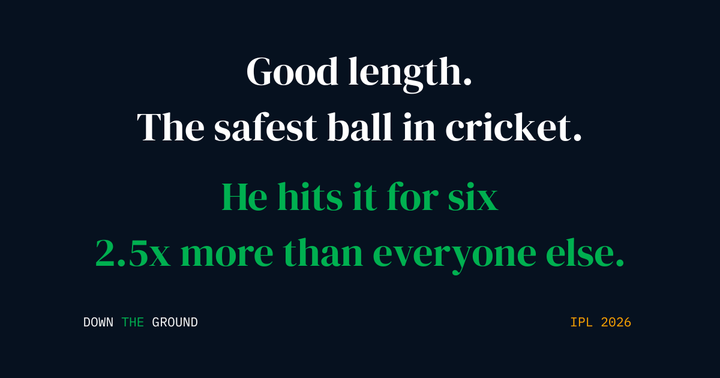
The numbers deserve close examination. His powerplay economy this season sits at 7.00, joint-best in the competition among bowlers with at least 50 powerplay balls bowled. His death economy is 7.83, also the best in the competition under the same minimum-overs threshold. He has 12 powerplay wickets at an economy of 6.91. He holds the all-time IPL record for most dot balls bowled, with 1,793. He has more powerplay wickets than any bowler in IPL history, with 81 at a career economy of 6.52 in that phase.
The comparison with his own 2016/17 peak is instructive because it does not simply confirm a "restored" bowler. His 2026 powerplay economy (7.00) is actually marginally worse than his 2017 overall economy (7.05). Where he has genuinely improved relative to his peak years is in strategic impact: his six three-wicket hauls this season have come at decisive phases of matches, and his death-bowling control at 7.83 is something the 2016/17 version could not have claimed with equal authority.
What the data does not fully explain is the mechanism. He has spoken about discipline rather than motivation as the driver: "motivation is a very overrated word for me... the thing that keeps me going is discipline". The practical elements, diligent physiotherapy, sustained domestic appearances for Uttar Pradesh, and the shift from SRH's increasingly batter-oriented environment to RCB's structure around bowling quality, all likely contribute. But those are qualitative explanations sitting beneath a quantitative phenomenon that stands almost alone in the format's 19-year history.
No other fast bowler with more than 100 IPL wickets has produced a comparable two-peak career arc. Lasith Malinga peaked early for Mumbai Indians and declined. Zaheer Khan peaked and retired. Dwayne Bravo's late productivity at CSK relied on slower pace and cunning rather than a genuine second performance peak. The closest parallel from any format may be baseball's starting pitching tradition, where the "second peak" concept is documented for a small subset of pitchers who reinvent their repertoire after declining velocity. In T20 cricket, with its compressed career windows and relentless market for young pace, that reinvention has essentially never happened for a seamer at this level.
At 36, with a third Purple Cap now within reach and RCB in the IPL 2026 playoffs, Bhuvneshwar Kumar is not just extending a career. He is occupying statistical territory that no fast bowler has mapped before.
| Season | Age | Wickets | Economy | Phase |
|---|---|---|---|---|
| 2014 | 24 | 20 | 7.22 | Peak begins |
| 2015 | 25 | 18 | 7.15 | Peak |
| 2016 | 26 | 23 | 7.42 | Peak — Purple Cap |
| 2017 | 27 | 26 | 7.05 | Peak — Purple Cap |
| 2018 | 28 | 9 | 7.64 | Decline begins |
| 2019 | 29 | 13 | 7.81 | Decline |
| 2020 | 30 | — | — | Injured out |
| 2021 | 31 | 3 | 9.10 | Decline |
| 2022 | 32 | 12 | 7.29 | Decline |
| 2023 | 33 | 16 | 8.19 | Revival begins |
| 2024 | 34 | 11 | 9.13 | Revival (dip) |
| 2025 | 35 | 17 | ~8.20 | Revival |
| 2026 | 36 | 24* | 7.46 | Second peak |